If you've ever wondered why writing a will still feels like it belongs in the 1950s, blame the laws, not the lawyers. Most states still require a physical signature, ink on paper, and two witnesses standing in the same room before a will counts as valid. A group called the LIVE Coalition has decided that's worth fixing, and after watching their work over the past several months, we think they deserve some attention.
Who They Are
LIVE stands for Legacy, Innovation & Virtual Estate Planning. The coalition launched in Washington, D.C. in early 2026 and describes itself as the first group focused entirely on modernizing the legal rules around estate planning for a digital world. Membership spans law, technology, consumer advocacy, and financial planning, and includes organizations we know and respect directly, like MemoriaSky and Executorium, along with our own affiliated site, ProbateCourtBond.com. Seeing names we trust already at the table made it a lot easier to take this coalition seriously.
For years, reform on electronic wills happened piecemeal. One company or bar association would push a bill in one state at a time, with mixed results, and nobody was coordinating the effort nationally. LIVE's whole premise is that a unified coalition carries more weight in a statehouse than any single organization pushing alone, and the results so far back that up.
The Problem They're Actually Solving
Here's the number that should bother everyone: more than two-thirds of Americans don't have a will or basic estate planning documents in place. That's not because people don't care about their families. A lot of it comes down to plain friction. Getting two witnesses in a room at the same time, finding an afternoon to sit down with a notary, mailing signed paperwork back and forth between family members who live in different states. Outdated execution rules turn something that should take twenty minutes into a weeks-long errand, and a lot of people never get around to finishing it.
LIVE's argument, and it's a fair one, is that digital tools don't replace attorneys. They just remove some of the friction so more families actually finish the process instead of abandoning it halfway through. Their own materials are refreshingly upfront about this: technology handles intake, signatures, and document storage more efficiently, which frees up attorneys, especially smaller and solo firms, to spend their time on the parts of the job that actually require legal judgment. Blended families, business succession, incapacity planning, contested estates. Those situations still need a real lawyer, and nothing about electronic wills changes that. If anything, digital tools tend to work as an on ramp. Someone starts with a simple online will and later comes back to an attorney once their situation gets more complicated.
What an Electronic Will Actually Requires
It helps to know what actually changes when a state passes one of these laws, because "electronic will" gets used loosely. In most states that have adopted it, an electronic will has to meet a few conditions. It has to be a record that's readable as text at the moment it's signed, meaning a video recording alone doesn't count. It has to be signed by the person making the will, using an electronic signature. And it has to be witnessed by at least two competent adults, either in person or through live audio-video technology, depending on what the specific state allows. Some states also require the document to be stored with a qualified custodian, which is meant to prevent tampering or someone claiming a will was altered after the fact.
Compare that to a traditional paper will, which needs a wet ink signature and witnesses physically present in the same room, and you can see why this matters for anyone who's deployed overseas, living with a mobility limitation, caring for a family member out of state, or just working a schedule that makes coordinating three adults in one room genuinely hard.
Where the Law Actually Stands
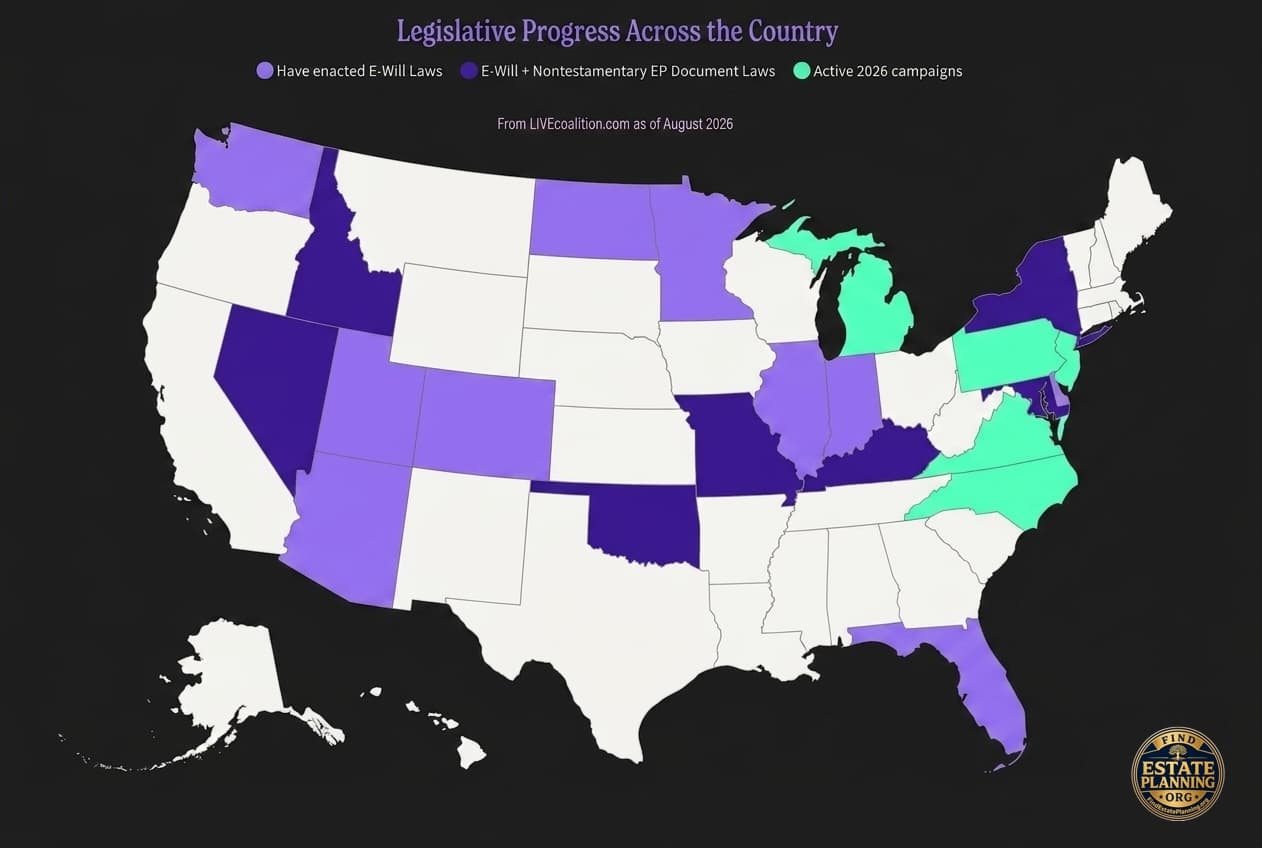
As of this year, 16 states plus D.C. have passed laws recognizing electronic wills in some form. Nevada was first back in 2017, and adoption was slow for a long time despite digital signatures becoming completely normal in banking, healthcare, and nearly every other part of daily life. That's changed recently. LIVE has been directly involved in a good chunk of the newer legislative wins, including recent passage in New York, Missouri, and North Dakota. Active campaigns are running right now in Michigan, New Jersey, and Pennsylvania, with California and Texas still on the coalition's longer term radar as the two largest holdout states.
One thing worth pointing out: this hasn't broken down along party lines the way a lot of legislation does. Reform has passed in states that lean in very different political directions, which tells you this is a practical fix that both sides can agree on, not a culture war fight dressed up as one.
 Frequently Asked Questions
Is an electronic will legal in every state? No. As of now, 16 states plus D.C. allow it in some form, and the specific requirements vary quite a bit from state to state. If you're not in one of those states, a traditional paper will with wet ink signatures and in-person witnesses is still what you need.
Does an electronic will mean I don't need an attorney? No. It changes how the document gets executed, not whether you need legal advice. Anyone with a business, blended family, complex assets, or unusual family situation should still work with an attorney regardless of whether the final document is signed on paper or electronically.
Will more states adopt this? Probably, based on the current trend. Legislation is pending or actively being pushed in several more states, and the fact that it hasn't become a partisan issue suggests the path forward is smoother than a lot of other legal reforms.
About FindEstatePlanning.org
FindEstatePlanning.org is a free, nationwide directory that helps families search for estate planning attorneys by city or ZIP code, covering wills, trusts, probate, elder law, special needs planning, business succession, and asset protection. We also run a public calendar of estate planning seminars and events, with one rule for inclusion: a licensed attorney has to be presenting, co-presenting, or hosting it. That filter exists because free "estate planning seminars" have a long history of being sales pitches for annuities or trust kits dressed up as education, often aimed at older adults who have no easy way to tell the difference before they walk in the door. We don't rate, rank, or endorse the attorneys or events listed here. We just make sure a real license is attached to the name on the flyer, and we try to make it easier for families to find the people and resources who can actually help.
Why We're Writing About LIVE
We're highlighting this work because it lines up with what this site is trying to do: make estate planning more accessible to the people who keep putting it off. If the laws in more states catch up to how people actually communicate and sign things today, more families will end up with an actual plan instead of nothing at all. That's a win regardless of who gets the credit for it, and it's a good sign for the movement that organizations like MemoriaSky, Executorium, and ProbateCourtBond.com already believe in this work enough to be part of it. You can follow the coalition's state by state progress at LIVEcoalition.com.